All about Torres del Paine
Real answers, not AI generated
Everything you need to know about Torres del Paine National Park - For Free



General Information
What does Paine mean?
“Paine” means “azul”.
How to pronounce Torres del Paine?
/ˈtɔːrɛs dɛl ˈpaɪneɪ/, The original Spanish pronunciation is [ˈtores ðel ˈpaɲe], where “Paine” is pronounced like “PAH-nyeh”. English speakers often anglicize it as “PIE-nay”. You can hear the right pronunciation: https://www.capyschool.com/es/reader
Why patagonia is famous?
Patagonia is famous for its wild landscapes, which include vast forests, glaciers, mountains, and rivers, as well as its rich native wildlife. Its main attractions are: stunning scenery, diverse wildlife, outdoor activities, a focus on sustainability, and geology and paleontology.
What is Torres del Paine known for?
Torres del Paine is a national park famous for its wild landscapes, especially the Paine Massif. Its main attractions are: Breathtaking landscapes, Wildlife diversity, Outdoor activities, Focus on sustainability, Geology.
What are the top attractions or landmarks?
- Mirador Base de Las Torres
- Mirador Grey
- Lake Pehoé
- W Circuit
- O Circuit
- Wildlife
- Navigation on Grey Lake
There are other attractions near Torres del Paine, such as Sierra Baguales, Milodón Cave, Balmaceda and Serrano Glaciers, and Magdalena Island (Punta Arenas), among others.
How many days should I spend there?
To make the most of Torres del Paine, it is recommended to spend at least 4 full days if you rent a car and explore the area on your own. Ideally, a full week will allow you to enjoy the main attractions and hiking trails.
If your goal is to hike the W Circuit, you will need 4 to 6 days.
If you plan to do the O Circuit, you will need 7 to 9 days.
How much money do I need to go to Torres del Paine?
Very sensitive topic, it all depends on your interests. If you are base in Puerto Natales and do day trip to the park. If you are busing or renting a car. If you drive and stay in a hotel inside the park, if you do the W tre or the O trek. If you are bringing your own gear or renting it in Puerto Natales. This is a very important questions, so sorry for not providing a specific answer.
Do I need to bring cash?
Chile is well developed and the majority of the business takes electronic payments, but like anywhere in the world, things can fail due weather conditions, so we recommend bringing cash just in case. If you have all booked and you are not part of a guided tour, a couple of hundreds would be fine. If you feel tipping people who help you on your experience, bring something extra on top of the couple of hundreds.
Is water drinkable in Puerto natales?
Yes, it totally fine drinking tap water, as well in Torres del Paine, including stream water.
Is it better to visit tdp or El Chalten if I only have 3 days?
In terms of logistics, Chile is easier to navigate in terms of visa, flight connections, internet connectivity, payments among other factors.
What is the best trek in Patagonia?
If you have time (up to 10 days), the O trek 100%. If you have less time, between 4-6 days, the W trek is for you.
What’s the Difference Between the O Trek and the W Trek in Patagonia?
Both the O Trek and the W Trek in Torres del Paine National Park are named after the shapes their routes form on the map. While they share some common sections, they offer very different experiences in terms of length, difficulty, and remoteness.
W Trek Overview
The W Trek traces the southern edge of the park and is designed to hit the iconic highlights. It follows three scenic valleys—Valle Ascencio, the French Valley, and the Grey Glacier valley—heading in and out from the same base trail, which gives it the “W” shape.
At 76 km, the W Trek is significantly shorter and more accessible than the O Trek. It’s ideal for those with limited time or less hiking experience, while still offering jaw-dropping views, abundant wildlife, and great photo opportunities.
O Trek Overview
The O Trek, makes a complete loop around the Paine Massif, including the entire W Trek section. It takes you into the remote and less-visited northern part of the park, where the scenery is more rugged and wild.
With a length of 136 km, the O Trek is more challenging and includes a few long hiking days. However, it’s considered one of the top 10 treks in the world—and for good reason. The sense of isolation, raw beauty, and ever-changing landscapes make it an unforgettable adventure.
W Trek Highlights
Las Torres – Iconic granite towers, especially magical at sunrise.
French Valley – A dramatic, glacier-fed valley with panoramic views.
Grey Glacier – A massive, blue-tinged glacier spilling into a lake.
Paine Grande – A scenic area offering views of lakes and jagged peaks.
Los Cuernos (The Horns) – Unique, horn-shaped mountains seen along the trail.
O Trek Highlights
John Gardner Pass – The highest and most challenging point of the trek, with epic views over the Southern Patagonian Ice Field.
Dickson Lake – A peaceful, remote lake framed by forests and mountains.
Los Perros Glacier – A lesser-known glacier near one of the O Trek’s wildest campsites.
Grey Glacier – Also part of the W Trek, but approached from a different, equally spectacular angle.
Backcountry Campsites – Fewer crowds and deeper immersion in untouched nature.
Summary
Feature | W Trek | O Trek |
Distance | ~76 km | ~136 km |
Duration | 4–5 days | 7–9 days |
Difficulty | Moderate | Moderate to Challenging |
Remoteness | Popular & Accessible | Remote & Wild |
Best for | Short trips, iconic views | Full immersion, fewer people |
Whether you choose the W or O, you’ll be surrounded by Patagonia’s raw, rugged beauty. The choice comes down to how much time and challenge you’re ready for.
When can I hike Torres del Paine without a guide?
Multi Day hikes:
Every year, between September (September to be confirmed due weather conditions) and April you can hike the W trek unguided. Normally between September and the 1st week of October is mandatory to take trekking poles and microspikes. The O trek you can do it unguided between November and March.Normally in November you need to take microspikes to be able to cross the John Garner Pass.
Every winter (May to August), accommodations are very limited along the W trek, but you can do both, W trek and the O trek, camping and guided. During winter, is mandatory to take microspikes, trekking poles and hiking boots (if you don’t have it, you can easily rent them at www.rentalnatales.com).
Day Hikes:
- Base Torres, between September (September [tbc] due weather conditions) and April you can hike it unguided. Normally between September and the 1st week of October is mandatory to take trekking poles and microspikes.
- Mirador Cuernos, unguided all year round.
- Mirador Condor, unguided all year round.
- Fauna Trail (between Portería Sarmiento and Portería Laguna Amarga), guided all year round.
- Mirador Ferrier, unguided all year round.
Do you need to be fit to go to patagonia?
It all depends on your interest, if you want to hike up to the Base Torres, The french valley or Glacier Grey Look out (1 day) or multiday hikes such as the W trek or the O trek, yes, you need to have a decent fit level.
Other shorter hikes like Mirador Cuernos (6.3km rt) or Fauna Trail (6.5 km) are super easy, Mirador Condor (2.4km rt) you need to be medium fit , Mirador Ferrier (5.6km rt) is short but difficult, so you need to be fit
If you want to take day tours from Puerto Natales like, Full Day Paine Tour, Lago Grey Navigation, Balmaceda and Serrano Glaciers, you don’t need to be fit, those tours are available for people from all ages (for Lago grey, there is as 30-40 min walk from the parking lot the the ferry).
Where to leave luggage in Puerto Natales?
Most accommodations in Puerto Natales offer free luggage storage for guests who stay before or after their trek. This is the easiest and most secure option. Just ask at check-in.
What to do in Puerto Natales?
Puerto Natales is the new hub for Patagonia and antarctica expeditions and from there you can organize different tours and experiences such us: Full Day Paine tour, Base Torres hike, Balmaceda and Serrano Glaciers Tour, Isla Magdalena Penguin Tour, Miradores del Paine Tour or Glacier Grey Day Tour. Also you can Walk the waterfront (Costanera), Visit the Museo histórico Municipal, Visit Etherh Aike Cultural Center (Pueblito Artesanal) visit the Cueva del Milodón, Cerro Dorotea, Enjoy a massage or sauna at local lodges, shop for souvenirs.
When not to go to Torres del Paine?
NEVER. You can visit and experience Torres del Paine all year round.
Each season offers something unique:
- Summer (Dec–Mar): Long days, open trails, warmer weather.
- Autumn (Apr–May): Fewer crowds, stunning fall colors.
- Winter (Jun–Aug): Snowy landscapes, peaceful solitude, and special guided experiences.
- Spring (Sep–Nov): Blooming wildflowers and active wildlife.
Just plan according to the season—some trails and services vary—but the park is always magical.
Is tap water safe to drink?
Yes, tap water in Torres del Paine is generally safe to drink, including water from most streams along the trails. Here’s what you should know:
Safe Sources
Refugios and campsites: Tap water is potable and comes from glacial or spring-fed sources.
Mountain streams and rivers: Often clean and safe, especially if the water is fast-moving and upstream from human activity.
Use Caution
Avoid drinking from still water (ponds, small lakes).
Be cautious near heavily trafficked campsites or downstream from toilets/trails.
If in doubt, use a filter, purification tablets, or a UV purifier.
Is Puerto Natales walkable?
Yes, Puerto Natales is very walkable. The town is compact and flat, so you can easily get around on foot. Here’s what you can expect:
What’s Within Walking Distance
Bus terminal to the Plaza de Armas: 10–15 minutes
Waterfront (Costanera): 5 – 10 minutes
Shops, restaurants, and cafés: Clustered within a few blocks of downtown
When You Might Need Transport
Cueva del Milodón (25 km away): Requires a car, tour or bike
Airport (PNT): 5-10 minutes by taxi
Puerto Natales is also safe, relaxed, and scenic, making walking extremely enjoyable.
What altitude Torres del Paine?
Torres del Paine National Park has relatively low elevation compared to many mountainous areas:
- Base of the Torres (Las Torres viewpoint): 870 meters above sea level
- John Gardner Pass (highest point on the O Trek): 1200 meters
- Refugios and campsites: Usually between 50 and 500 meters
There’s no risk of altitude sickness while trekking in Torres del Paine.
Can you do day hikes from Puerto Natales?
Yes, you can do it through a tour company (like Tour Natales) the following hikes: Mirador Base Torres, The French Valley or Glacier Grey Look out, Mirador Condor, Mirador Cuernos or Mirador Ferrier or Fauna Trail.
If you have a car you can do on your own: Base Torres, The french valley or Glacier Grey Look out, Mirador cóndor, Mirador cuernos, Mirador ferrier, cerro benitez, cerro dorotea.
Should I get a local SIM card?
Yes, getting a local SIM card in Chile is a good idea, especially if you want reliable mobile data for navigation, or emergency use while traveling. Here’s what to consider:
Benefits:
- Affordable prepaid plans with data and local calls
- Better coverage in towns like Puerto Natales and on the road
- Useful for booking transport, checking weather, and staying connected
Limitations:
- No signal inside most of Torres del Paine National Park, regardless of carrier
- Coverage may be limited in remote areas of Patagonia
Recommended Providers:
- Entel – Best coverage in Patagonia
Where to buy:
- Kiosks or official stores in Santiago or Puerto Natales
- You’ll need your passport to register the SIM
Is there any gas station inside the park?
No, there isn’t, the last option to refill your tank is in Puerto Natales, at Copec, Aramco or Shell. If you are staying inside the park you can rent a gasoline/diesel canister at www.rentalnatales.com
Is there good Wi-Fi or mobile coverage?
Most of the hotels inside the park have Starlinks so inside their buildings, the internet connection is pretty good. Mobile coverage inside the park is very limited, especially with ESIM or Roaming providers. It is recommended to buy a local sim card from Entel.
Are Debit and Credit Card accepted in Patagonia?
Yes, Debit and Credit cards are widely accepted. This includes WISE, REVOLUT, N96, MONZO, among others. It is recommended that you ask the business if they accept any of these cards, as they may have an account with the same provider, which could save you international usage fees.
Costs & Budget
Is it expensive to travel there?
Traveling to Torres del Paine can be as expensive or as budget-friendly as you make it, depending on your choices for transport, accommodation, food, and trekking style.
Budget Breakdown:
- Transport
Buses from Puerto Natales to the park: $30.000 CLP (round-trip).
Flights to Punta Arenas or Puerto Natales: Varies (domestic flights in Chile can be cheap if booked early).
- Park Entry
Torres del Paine entrance fee (2025): $39.500 CLP (US$45) for foreigners
Valid for multiple days, but must be paid in advance online at www.pasesparques.cl
- Accommodation
For multiday treks (the W or the O):
Refugios: US$65–210 per night (vertice.travel and www.lastorres.com)
Campsites with your own gear: US$12–85 per night (vertice.travel and www.lastorres.com)
Full-service campsites (with tent, mat, sleeping bag): US$200–270 per night (vertice.travel and www.lastorres.com)
Hotels (2 people): from US250 per night up to US3.000
- Food
Refugio meals: Around US100 (breakfast, lunchbox, dinner)
Self-catering: Cheaper if you bring your own food or buy supplies in Puerto Natales
- Gear Rental
Full set (tent, mat, sleeping bag, poles): From US$33 per day from places like Rental Natales
- Guided Tours
Multi-day guided treks: US$1.500–5.000
Day trips from Puerto Natales: US$80–150
Verdict:
Backpackers and campers: US$30–60/day possible
Mid-range with some comforts: US$100–200/day
Luxury lodges or guided treks: US$300+/day
It’s not cheap, but it’s possible to do Torres del Paine on a budget if you’re flexible, plan early, and camp or cook for yourself.
Are there any free things to do?
Yes, a fewer things you can do for free, like Walk the waterfront (Costanera),Visit Etherh Aike Cultural Center (Pueblito Artesanal), Wander around and spot Patagonian-themed murals and metal sculptures or hike the cerro Benitez.
Also there are few low budget options to consider; Visit the Museo histórico Municipal, trekking in cerro Dorotea.
Do you need cash in Torres del Paine?
Chile is well developed and the majority of the business takes electronic payments, but like anywhere in the world, things can fail due weather conditions, so we recommend bringing cash just in case. If you have all booked and you are not part of a guided tour, a couple of hundreds would be fine.
If you feel tipping people who help you on your experience, bring something extra on top of the couple of hundreds.
Accommodation
Where should I stay and what are the best areas/neighborhoods?
Anywhere in Puerto Natales is safe to stay and very quiet. But if you like to walk around any accommodation that is between 4-6 blocks away from the main square it would be fine.
Are there hostels, hotels, or Airbnb options?
There are hundreds of options in Puerto Natales, it is all about your budget. If you are looking for a nice hotel, Best Wester, Altiplanico, Remota, NOI, The Singular, Vendaval, Big Sur and Vinnhaus are good options. Hostal Baquedano, Hostal America, Xalpen, Hostel Natales or Last Hope hostel are more budget friendly with an excellent quality.
Inside Torres the paine national park, there are options like Hotel Lago Grey, Hotel Explora, Eco Camp or Hotel Las Torres on the high end, More budget friendly there are Hostería Pehoé and Camping Pehoé.
Outside of Torres del Paine, there are other options like Hotel Rio Serrano, Chile Nativo Riverside Glamping, Camping Río Serrano (caja los andes), Pampa Lodge, Tierra Patagonia.
What are the best places to stay on or near torres del paine with kids?
- Hotel Las Torres
- Explora Patagonia
- Refugio Paine Grande
- Hotel Lago Grey
- EcoCamp Patagonia
- Tierra Patagonia
- Pampa Lodge
- Camping Pehoé
How far in advance should I book Torres del Paine?
For Torres del Paine, it’s best to book well in advance, especially during the high season (November to March). Here’s a general guide:
- Refugios and campsites: 6-8 months in advance
- Hotels and lodges: 6-8 months in advance
- Park entrance ticket: At least 1 week in advance, online only www.pasesparques.cl
- Catamaran (Pudeto–Paine Grande): 2-3 weeks in advance www.catamaranpehoe.com
- Buses from Puerto Natales: 1–2 weeks in advance (earlier in peak season)
Transportation
What’s the best way to get around (public transport, rental car, walking)?
It all depends on what you are doing. If you are doing the W trek or the O trek on your own, public transportation is the way to go. If you are going on a guided trip, you don’t have to worry, the company will take care of your transportation. If you are a photographer or day hiker, renting a car is the best way, as there isn’t any public transportation inside the park so having your own transportation is the best option.
Is it easy to travel between towns/cities nearby?
The main cities tourists visit when they come to Torres del Paine are El Calafate (Argentina) and Punta Arenas, so travelling between those cities is very easy on public transportation. During the high season it is highly recommended to book buses at least 1 week in advance. Between Puerto Natales and El Calafate, it is recommended to do it at least 2 weeks in advance between November and February.
How long is the bus from Puerto Natales to Torres del Paine (Bus Sur)?
Puerto Natales- Laguna Amarga: ~2hrs
Puerto Natales- Pudeto: ~3.5 hrs
Puerto Natales-Administración: ~ 4hrs
Puerto Natales- Hotel Lago grey: ~4.15 hrs
Estimated return times to Puerto Natales from Torres del Paine, usually are:
13:00
17:05
21:30
Is Uber available in Puerto Natales?
Yes, there are uber in Puerto natales. Use it only for Puerto Natales. If you need private transportation (link TN) to Punta Arenas, Calafate or Torres del Paine, use a bigger, safer and registered vehicle (Department of Transport).
Can I drive inside Torres Del Paine?
Yes, you can. As you drive mostly on dirt road, rent at least a SUV.
Where can I park my campervan overnight in Torres del Paine?
There are 2 campsites inside the park, where you can get some facilities are Laguna Azul (Toilet and cooking facilities) and Camping Pehoé (Toilet, restaurant, kiosk). You can also park at the Welcome Center (private property, no free facilities) and Guardería Pingo and Administración (free and toilet available [no showers]).
Can I park my car overnight in Pudeto?
Yes, you can.
Can I park my car overnight at the welcome center/central area?
Yes, you can.
Can I park my car overnight at Porteria Laguna Amarga?
No, you can’t.
On which side of the plane do I have to sit to see the Torres del Paine Paine if I fly from SCL to PNT?
When flying from SCL to PNT or PUQ, you should sit on the left-hand side of the plane (seat A).
If you are flying from PNT or PUQ to SCL, you should sit on the right-hand side of the plane (seat F).
Where can I buy the ticket for the catamaran across Lake Pehoé?
You have to buy the ticket at catamaranpehoe.com
Food & Drinks
What are the must-try local dishes?
The main dishes are Patagonian Lamb and King Crab. There are several restaurants that serve that kind of food. As well there are some other local dishes you can try like Guanaco meat, Upland Goose among others.
Are there vegetarian/vegan options?
Yes, in Puerto Natales pretty much all the restaurants have options for vegan and vegetarian.
All the hotels inside the park will have options for you, but if you are doing the W trek or the O trek and you are booked the full board, make sure you contact the companies you booked through about your food requirements.
What are the best restaurants or cafés?
Afrigonia, Santolla, El Brisket, Bahía Mansa, La Disquería, Mesita Grande.
Is tap water safe to drink?
Yes, tap water in Torres del Paine is generally safe to drink, including water from most streams along the trails. Here’s what you should know:
Safe Sources
Refugios and campsites: Tap water is potable and comes from glacial or spring-fed sources.
Mountain streams and rivers: Often clean and safe, especially if the water is fast-moving and upstream from human activity.
Use Caution
Avoid drinking from still water (ponds, small lakes).
Be cautious near heavily trafficked campsites or downstream from toilets/trails.
If in doubt, use a filter, purification tablets, or a UV purifier.
Pro Tip
Most hikers drink untreated stream water throughout the park, but carrying a lightweight filter or tablets is a smart backup, especially in peak season.
How is the food situation for the W and O trek?
- Bring Your Own Food (Most Budget-Friendly)
- Buy Full-Board Meals from Refugios (Easiest Option)
- Mix of Both (Most Popular Option)
Where can I buy Freeze dried meals?
You can buy it them at Rental Natales.
Activities & Experiences
What are the best things to do?
Torres del paine is a magnificent place, with many activities to do, like camping, trekking, photography, kayaking, sightseeing or nature observation are some of the options. Some activities are:
Multiday Hikes:
1- W trek: The W Trek traces the southern edge of the park and is designed to hit the iconic highlights. It follows three scenic valleys—Valle Ascencio, the French Valley, and the Grey Glacier valley—heading in and out from the same base trail, which gives it the “W” shape.
At 76 km, the W Trek is significantly shorter and more accessible than the O Trek. It’s ideal for those with limited time or less hiking experience, while still offering jaw-dropping views, abundant wildlife, and great photo opportunities.
2- O trek: The O Trek, makes a complete loop around the Paine Massif, including the entire W Trek section. It takes you into the remote and less-visited northern part of the park, where the scenery is more rugged and wild.
With a length of 136 km, the O Trek is more challenging and includes a few long hiking days. However, it’s considered one of the top 10 treks in the world—and for good reason. The sense of isolation, raw beauty, and ever-changing landscapes make it an unforgettable adventure.
Day Trips:
3- Kayaking at Lago Grey: Paddle near floating icebergs and along the face of the stunning Grey Glacier. Guided tours offer a unique perspective of the glacier and safe, close encounters with Patagonian ice formations.
4- Hiking The Base Torres (part of the W and the O trek): One of the most iconic hikes in Patagonia, this challenging full-day trek takes you to the foot of the famous granite towers (Las Torres). It’s part of both the W and O treks and offers breathtaking views, especially at sunrise.
5- Hike the French Valley (part of the W and the O trek): A dramatic and scenic trail that leads through a forested valley surrounded by glaciers, waterfalls, and jagged peaks. The viewpoint at the heart of the valley offers panoramic views of the Paine Massif.
6- Hike the Glacier Grey Look out (part of the W and the O trek): This trail provides expansive views over Grey Glacier from above. You’ll hike through varied terrain to reach the lookout, where you can witness the vast ice field flowing into Lago Grey.
7- Horseback Riding: Available near several park entrances and estancias, horseback riding lets you explore the Patagonian steppe, rivers, and foothills the traditional way — guided by local baqueanos (cowboys).
8- Nature Photography: Torres del Paine is a photographer’s dream, with dramatic landscapes, surreal light, and abundant wildlife. Bring a zoom lens for guanacos, foxes, and possibly pumas, or a wide-angle for iconic peaks and glacial lakes.
9- Puma Sighting: With patience and a guide, you may spot Patagonia’s elusive big cat. The best chances are at dawn or dusk near Laguna Amarga or around the eastern side of the park, especially in shoulder seasons.
What tours or excursions are worth it?
If you have limited time and want to see most of the park, from Puerto Natales you can take a tour called Full Day Paine, which is a sightseeing tour which visits the main lookouts along the park (you can also do it on your own car). The other option is to hike to the Base of the Torres, which is a 20km (rt) hike to see the 3 Torres.
Are there any local festivals or events?
During spring and summer there are a few event:
https://www.patagonianinternationalmarathon.com/
https://patagoniarunningfestival.com/
https://experience.fjallraven.com/classic/chile
Fiesta a la chilena in Cerro Castillo, https://www.munitorresdelpaine.cl/fiesta-a-la-chilena/
What’s a good itinerary for 3/5/7 days?
Excluding the W or the O trek
If you have your own transportation and you are staying inside or near the park (3 days itinerary):
- Drive along the park up to Laguna Azul
- Hike Mirador Condor, Cuernos and/or Ferrier
- Hike Base Torres del Paine or Lago Grey Navigation (if you don’t want to hike 20km)
If you have your own transportation and you are staying inside or near the park (5 days itinerary):
- Drive along the park up to Laguna Azul
- Hike Mirador Condor and Cuernos
- Hike Base Torres del Paine
- Lago Grey Navigation hike to Mirador Ferrier
- Balmaceda and Serrano glaciers (Puerto Natales)
- Kayaking River Grey
If you have your own transportation and you are staying inside or near the park (7 days itinerary):
- Drive along the park up to Laguna Azul
- Hike Mirador Condor and Cuernos
- Hike Base Torres del Paine
- Lago Grey Navigation / hike to Mirador Ferrier
- Balmaceda and Serrano Glaciers (Puerto Natales)
- Kayaking River Grey
- Puma tour 1 or 2 days
What are the best activities in Torres del Paine with kids?
Drive along the park up to Laguna Azul
Hike Mirador Condor, Cuernos and/or Ferrier
Lago Grey Navigation (if you don’t want to hike 20km)
Balmaceda and Serrano glaciers (Puerto Natales)
How hard is the hike to base tores del paine?
On a scale from 1-10. It is a 7, for someone active on a decent shape.
What is the difference between 4 days and 5 days on the w trek?
The extra day, either at the beginning or at the end of the W trek, gives you the time to hike up to the suspension bridges (5.5km past Refugio Grey). Recommendation: Do 5 days,and if you have and extra day, you can do kayaking or Ice Hiking at Glacier Grey.
Can you hike Torres del Paine without a guide?
Multi Day hikes:
Every year, between September (September tbc due weather conditions) and April you can hike the W trek unguided. Normally between September and the 1st week of October is mandatory to take trekking poles and microspikes. The O trek you can do it unguided between November and March.Normally in November you need to take microspikes to be able to cross the John Garner Pass.
Every winter (May to August), accommodations are very limited along the W trek, but you can do both, W trek and the O trek, camping and guided. During winter, is mandatory to take microspikes, trekking poles and hiking boots (if you don’t have it, you can easily rent them at www.rentalnatales.com).
Day Hikes:
Base Torres, between September (September tbc due weather conditions) and April you can hike it unguided. Normally between September and the 1st week of October is mandatory to take trekking poles and microspikes.
Mirador Cuernos, unguided all year round.
Mirador Condor, unguided all year round.
Fauna Trail (between Portería Sarmiento and Portería Laguna Amarga) guided all year round.
Mirador Ferrier, unguided all year round.
How far in advance should I book day trips?
At least a week in advance, during high season if it is a last minute trip. If you like to be worry free during your holidays, book as soon as you book your trip (flights and accommodations).
How long does it take to hike the W trek and the O trek?
Feature | W Trek | O Trek |
Distance | ~76 km | ~136 km |
Duration | 4–5 days | 7–9 days |
Difficulty | Moderate | Moderate to Challenging |
Remoteness | Popular & Accessible | Remote & Wild |
Best for | Short trips, iconic views | Full immersion, fewer people |
Where to drive into for Torres del Paine?
To drive into Torres del Paine National Park (TDP), there are three main entrances, and the best one for you depends on your starting point and itinerary.
Main Entrances to Drive Into Torres del Paine:
1. Laguna Amarga (Main Entrance)
Best for: W Trek, O Circuit, visiting Base Torres.
Coordinates: -50.5202, -72.7574.
Toll booth/CONAF office: Yes (mandatory for park entry).
Services nearby: Guardería, info point, and shuttles to Las Torres area.
Popular with: Most hikers and tour groups.
2. Sarmiento Gate
Best for: Scenic route into the park, central lodging (Hotel Lago Grey, etc.).
Coordinates: -50.5855, -72.7973.
Toll booth: Smaller, quieter entry.
Connected to: Central and western zones of the park.
Good option if: You want to explore the park from west to east or stay in hotels like Explora, Lago Grey, or Pehoé.
3. Río Serrano Gate
Best for: Entering from Puerto Natales or southern area.
Coordinates: -51.2177, -72.9631 (Río Serrano Area).
Closest to: Hotel Río Serrano, Pueblito Serrano, kayak and boat excursions.
Which Entrance Should You Use?
Your Goal | Best Entrance |
W Trek / O Circuit | Laguna Amarga |
Hotel Lago Grey / Pehoé / Explora | Sarmiento Gate |
Hotel Río Serrano / Excursions | Río Serrano Gate |
Coming from Argentina (El Calafate via Cerro Castillo) | Laguna Amarga |
What is the cancellation policy for tours?
For most of the day tours you can cancel between 48hr-72hr in advance to get full refund (it all depend on the company).
What is the cancellation policy for park entry?
According to the official booking website (pasesparques.cl), entry tickers are not refundable. Unless there is a major event and the park closes.
What is the cancellation policy for the catamaran Pehoé?
You can change or cancel the date or time up to 72 hrs before departure for a fee of USD 5.
I chose the wrong date for my park entry?
You must reschedule at least 24 hrs before the entry date on your pass, and you can only do this once. You can select a new entry date within one month of the original date.
Location
Where is Chile?
Chile is a long and narrow country located along the southwestern coast of South America. It stretches over 4,300 km (2,670 miles) from north to south, bordered by:
- Peru to the north
- Bolivia and Argentina to the east
- The Pacific Ocean to the west
It is known for its diverse geography, including deserts (like the Atacama), fertile valleys, mountains (the Andes), forests, lakes, glaciers, and fjords—especially in Patagonia, in the southern part of the country. The capital city is Santiago.
Where is Patagonia?
Patagonia is a vast region located in the southern part of South America, spanning two countries:
- Southern Chile (western Patagonia)
- Southern Argentina (eastern Patagonia)
It stretches from around the Rio Colorado in Argentina and Reloncaví Sound in Chile all the way down to Tierra del Fuego at the southern tip of the continent.
Patagonia is known for its dramatic landscapes, including:
- Towering mountains (like the Andes)
- Glaciers (such as Perito Moreno and Grey Glacier)
- Windswept steppes and fjords
- Iconic national parks like Torres del Paine (Chile) and Los Glaciares (Argentina)
Major towns include Puerto Natales and Punta Arenas in Chile, and El Calafate and Bariloche in Argentina.
Where is Puerto Natales?
Puerto Natales is a small city in southern Chilean Patagonia, located in the Magallanes Region. It sits on the shore of the Última Esperanza Sound, about:
- 250 km (155 miles) north of Punta Arenas, the main regional airport
- 112 km (70 miles) south of Torres del Paine National Park, the main reason most travelers visit the area
Where is Torres del Paine National Park?
Torres del Paine is located in southern Chilean Patagonia, within the Magallanes Region of Chile. It is about 112 km (70 miles) north of Puerto Natales, the nearest town and main gateway to the park, and roughly 340 km (210 miles) north of Punta Arenas, the largest city in the region.
Where is Glacier Grey located in Torres del Paine?
Grey Glacier is located in the western section of Torres del Paine National Park, Chile.
Specifically, it lies:
- At the end of Grey Lake, where the glacier flows down from the Southern Patagonian Ice Field
- Along the W Trek and the O Circuit, between Paine Grande and Refugio Grey
- Near the John Gardner Pass, one of the most scenic and challenging parts of the O Circuit
It’s one of the park’s most iconic sights and can be viewed by hiking, kayaking, or taking a boat tour from Hotel Lago Grey.
Where is Mirador Base Torres located in Torres del Paine?
Base Torres, also known as the Mirador Las Torres, is the iconic viewpoint at the end of the Ascencio Valley trek in Torres del Paine National Park:
It’s located on the eastern side of the park—the tip of the “W” in the classic W Trek
The trail starts near the Las Torres Welcome Center, just past the main entrance at Laguna Amarga
The hike is approximately 20–21 km round trip with a ~900 m elevation gain, typically taking 8–10 hours
En route, hikers pass through Campamento Chileno, cross the Ascencio River, and ascend moraine slopes before reaching the turquoise glacial lake beneath the granite towers
Where is Pudeto located in Torres del Paine?
Pudeto in Torres del Paine is the western gateway on Lake Pehoé, essential for trekkers and visitors exploring the park:
- It’s a boat dock (jetty) on the shore of Lake Pehoé, where hikers catch the catamaran to/from Refugio Paine Grande on the W and O circuits
- Located just east of the Salto Grande waterfall, it serves as a key access point to trails near Los Cuernos and French Valley
- The Pudeto Catamaran Cafe and parking area are right next to the pier, providing snacks, restrooms, and parking for those staying in vehicles
- Pudeto is your starting point on Lago Pehoé for the ferry crossing to Paine Grande and French Valley, making it a central hub on the western side of the park.
Where is Laguna Amarga located in Torres del Paine?
Laguna Amarga is located at the eastern entrance of Torres del Paine National Park in Chilean Patagonia.
- It serves as the main vehicle entrance and checkpoint to the park.
- It’s the closest access point to Base Torres, Refugio Torre Central, and Refugio Torre Norte.
- From Laguna Amarga, travelers can take a shuttle van (or hike) to the Las Torres Welcome Center, which is the starting point for the Base Torres hike.
- The CONAF ranger station and ticket office are located here.
Many buses from Puerto Natales stop at Laguna Amarga to let trekkers start the W or O trek.
Where is Laguna Azul located in Torres del Paine?
Laguna Azul is located on the eastern side of Torres del Paine National Park, about a 20-minute drive north of the Laguna Amarga entrance . It sits alongside a northeastern access road and includes a small parking area and CONAF hut
From the parking lot at Laguna Azul, you can take easy hikes:
- A 1‑hour walk to a viewpoint overlooking the lagoon with the Paine Towers in the background
- A 2‑hour return trail leads to Laguna Cebolla, ideal for family outings or relaxed exploration
- The area is noted for its striking blue water, excellent wildlife viewing (guanacos, condors, armadillos), and birdwatching opportunities
- It’s accessible year‑round.
Where is Río Serrano Area located in Torres del Paine?
The Río Serrano Area is located on the southwestern edge of Torres del Paine National Park, just outside the park boundaries. It’s a key access point and service hub for visitors.
- It sits along the Serrano River, near the Serrano Entrance to the park.
- Located about 80 km from Puerto Natales by road (approx. 2 hours by car).
- It’s home to Villa Río Serrano, a small community with lodges, cabins, campsites, restaurants, and tour operators.
- From here, visitors can:
- Enter the park via the Serrano gate
- Join kayak tours to the Serrano and Balmaceda Glaciers
- Take scenic boat trips or overland tours
- Start hikes toward Lago Toro, Lago del Toro Lookout, and Pingo Valley
This area is popular for those seeking quieter stays and alternative access to the park without the busier east side trailheads.
Where are the park entries?
Torres del Paine National Park has three main official entrances, each providing access to different parts of the park:
1. Laguna Amarga Entrance
Location: Eastern side of the park
Main use: Starting point for the Base Torres hike and access to Refugio Torre Central/Norte
Services: CONAF office, bus stop, shuttles to Las Torres area
2. Serrano Entrance
Location: Southern side of the park, near Villa Río Serrano
Main use: Closest entry if arriving from Puerto Natales by car
Nearby: Hotels, lodges, and access to Lago Toro, Serrano River, and kayaking routes
3. Lake Sarmiento Entrance
Location: Southeast of the park
Main use: Less used, ideal for self-drivers, offers access to Laguna Amarga area via secondary routes
Nearby attractions: Great views of Lake Sarmiento and guanaco spotting
If you’re arriving by bus, you’ll most likely enter through Laguna Amarga. For drivers, both Serrano and Sarmiento are convenient depending on your route.
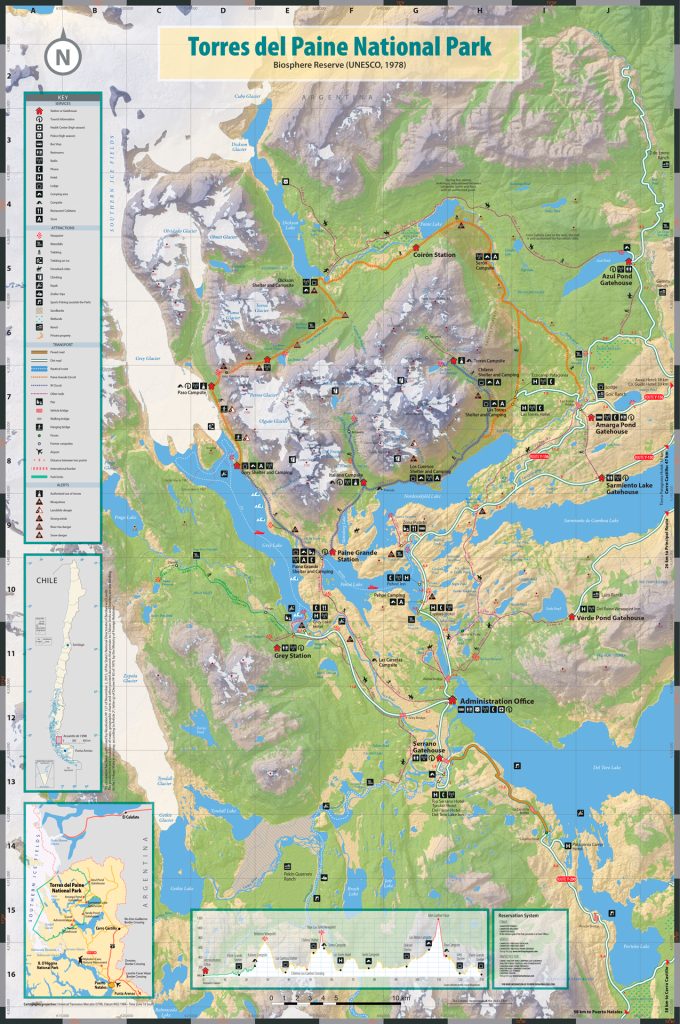
Map
Getting to Torres del Paine
How do I get to Torres del Paine?
Before getting into Torres del Paine, you need to get to Puerto Natales, which is the main town, a hub of tourism businesses, where you can rest or resupply food and gear before going to Torres del Paine.
To get to Puerto Natales you can fly directly from Santiago or Puerto Montt via Skyairlines or Latam.
Also you can fly to Punta Arenas from Santiago or Puerto Montt via Skyairlines or Latam, and then take a bus to Puerto Natales.
As well you can take a Ferry from Puerto Montt to Puerto natales via www.navimag.com or if you are coming down from Carretera Austral you can take a ferry from Puerto Yungay to Puerto Natales via www.tabsa.cl.
If you are coming from Argentina from El Calafate you can take a bus to Puerto Natales.
If you are coming from Argentina from Ushuaia you can take a bus to Punta Arenas and then another bus to Puerto Natales.
Now, as you know how to get to Puerto Natales, here is how you can get into Torres del Paine
Torres del Paine has 3 main entrances, Porteria Serrano, Portería Sarmiento and Porteria Laguna Amarga.
If you are going to do the W trek or the O trek, from Camping Central / Welcome Center, to get there, you can go by bus from Puerto Natales via Bus Sur, Buses Gomez, Buses Base Torres, you get off at Laguna Amarga (where the rangers check your park entry), then you take a shuttle (first come first serve) from Laguna Amarga to the welcome center. If you are renting a car, you can get all the way to the welcome center and park there.
If you are going to do the W trek or the O trek, from Paine Grande, to get there, you can go by bus from Puerto Natales via Bus Sur, Buses Gomez, Buses Base Torres, you get off at Laguna Amarga (where the rangers check your park entry), get back TO THE SAME BUS and continue to Pudeto, where you get off and board the ferry, make sure to book in advance your ticket in www.catamaranpehoe.com.
If you are going to do the W trek or the O trek, from Refugio Grey via Lago grey Navigation, to get there, you can go by bus from Puerto Natales via Bus Sur, Buses Gomez, Buses Base Torres, you get off at Laguna Amarga (where the rangers check your park entry) get back TO THE SAME BUS and continue to Hotel Lago Grey, where you get off, check-in at the hotel, walk 30-40 min along the shore and board the ferry, make sure to book in advance your ticket in lagogrey.com or any tour company like tournatales.cl.
If you are staying inside the park (hotel/ campsite) or driving everyday into the park you can use any of the 3 main entrances all day long. Make sure you have a good car SUV are recommended.
You can also access the northern side of the park, Laguna Azul area only with private transportation.
If my flight stop over in Puerto Montt, do I need to change a plane?
No, you don’t. You have to wait inside the plane.
Can I drive between Puerto Natales and Torres del Paine?
Yes, you can. As you drive mostly on dirt road, rent at least a SUV.
Can I get to El Chalten or El Calafate after Torres the Paine. Is there a direct bus ride there?
No, there isn’t any direct bus from Torres del Paine to Argentina. You need to go back to Puerto Natales.
Weather & Climate
How is the weather in Torres del Paine?
The weather in Torres del Paine is famously unpredictable — you can experience all four seasons in a single day. Here’s a general idea of what to expect:
Summer (Dec–Feb)
- Temps: 5 °C to 18 °C
- Long daylight (up to 17 hours)
- Strong winds (up to 100 km/h) are common
- Best time for trekking, but also most crowded
Autumn (Mar–May)
- Temps: 0 °C to 12 °C
- Fewer visitors, beautiful fall colors
- Less wind than summer, but increasing rain/snow
Winter (Jun–Aug)
- Temps: -5 °C to 8 °C
- Snow possible, some trails and refugios closed
- Fewer crowds, great light for photography
- Only suitable for experienced hikers or guided trips
Spring (Sep–Nov)
- Temps: 0 °C to 15 °C
- Melting snow, blooming wildflowers
- Wind begins to pick up again
- Shoulder season: fewer people, but services reopen
General Tips:
- Wind is the most consistent factor year-round
- Rain is possible any day — waterproof gear is essential
- UV is strong; wear sunscreen even on cloudy days
- Always dress in layers — and bring a windproof outer shell
What is the best time of the year to go to Torres del Paine?
Any time of the year is great to visit — it all depends on what you want to experience.
If you want to hike the W Trek or the O Trek, anytime between October and April is ideal.
If you’re a landscape photographer, March and April (autumn) are excellent months for capturing dramatic colors and light.
If you’re interested in seeing more wildlife, visit in November or December.
For those who want to hike independently and avoid crowds, September or October are great options.
If you’d like to hike and see very few people, go between May and September — just keep in mind that a certified guide is required from May to August.
If you don’t mind the crowds — which can be avoided by starting your hikes very early — and you want better chances of dry or stable weather, November to February is your best bet.
In summary: the best time to visit depends on your interests and budget, as some months are more expensive than others.
When is the best time to go to Patagonia
The best time in Patagonia is being in Patagonia.
Where can I check the weather for Torres del Paine?
The best place to check the weather is www.windguru.cz.
Language & Culture
Do people speak English?
No, in Chile Spanish is the official language. But if you are looking to book an experience such as Hotel, Tour, Gear Rental, Rent a Car and their website or their responses via Whatsapp or email are written in good English, those are the best options, despite the price. Communication is key for a good experience.
What are the basic phrases I should know?
Greetings & Politeness
Hola – Hello
Buenos días – Good morning
Buenas tardes – Good afternoon
Buenas noches – Good evening/night
¿Cómo está? – How are you?
Gracias – Thank you
Por favor – Please
Disculpe / Perdón – Excuse me / Sorry
De nada – You’re welcome
Essential Travel Phrases
¿Habla inglés? – Do you speak English?
No hablo mucho español – I don’t speak much Spanish
¿Cuánto cuesta? – How much does it cost?
¿Dónde está el baño? – Where is the bathroom?
Una mesa para dos, por favor – A table for two, please
La cuenta, por favor – The check, please
Agua sin gas / con gas – Still / sparkling water
No como carne – I don’t eat meat
¿A qué hora sale el bus? – What time does the bus leave?
Outdoor & Trekking Related
Sendero / Camino – Trail / Path
Mapa / Ruta – Map / Route
Refugio / Camping – Shelter / Campsite
Estoy cansado/a – I’m tired
Necesito ayuda – I need help
¿Cuánto falta? – How much farther?
Are there any cultural customs or etiquette tips?
General Etiquette
Greet with a “Hola” or “Buenos días”, friendly greetings go a long way, even with strangers.
Chileans are polite and reserved; avoid being loud or overly familiar at first.
Say “gracias” and “por favor” often, manners are important.
Wait for a greeting or permission before using someone’s first name.
In the Park (Torres del Paine)
Leave No Trace: Pack out all trash. Littering is taken seriously.
Stay on marked trails, going off-trail damages fragile ecosystems.
Camp only in official sites, wild camping is not allowed.
Fires are strictly prohibited (unless using designated cooking shelters or stoves).
Don’t feed or approach wildlife, including guanacos, pumas and foxes.
In Puerto Natales
Good businesses open early and closes late, without siesta time.
Tipping: A 10% tip is customary in restaurants if service is not already included.
Cash is preferred in smaller shops; many accept cards, but always carry some Chilean pesos.
Locals are used to tourism, don’t hesitate to ask for help or directions.
Respect for Nature & Culture
Patagonia is deeply valued by locals — treat the landscape with respect.
Patagonian identity is rural and nature-centered; people often take pride in simplicity, endurance, and local knowledge.
Be patient — things move at a slower pace than in big cities.
Entry & Safety
Do I need a visa in Chile?
Most nationalities do not need a visa for tourist stays of up to 90 days. Upon arrival, you will receive a Tourist Card (Also known as the PDI paper that looks like a receipt), which you must keep. This document also allows you to access benefits such as VAT exemption on accommodations.
- Visa: Most nationalities, including citizens of the United States, the European Union, Canada, and other Latin American countries, do not require a visa to enter Chile for tourism and can stay for up to 90 days.
Requirement for Australians: Since May 9, 2020, Australian citizens must obtain an eVisa before traveling to Chile.
Do I Pay taxes in Chile?
Yes, you do. However, you can only be exempt from taxes on accommodation if you have:
- Tourist Card: Upon entering the country, a Tourist Card (also known as the “PDI slip”) will be issued, which you must keep during your stay and hand over when you leave. This card is essential for certain benefits, such as VAT exemption on accommodations.
- VAT Exemption (19%) on Accommodations.
- Conditions for Exemption:
- Present the Tourist Card issued upon entry.
- Pay for accommodations in foreign currency (such as U.S. dollars or euros) or with a credit card issued outside of Chile.
- The hotel must be registered with the Internal Revenue Service (SII) and offer this exemption.
- Important: If you pay in Chilean pesos or if the hotel is not registered to offer the exemption, the 19% VAT will apply.
- Conditions for Exemption:
Do I need a park ticket to enter Torres del Paine?
Yes you do, you can buy it in: www.pasesparques.cl/en/parks/torres-del-paine
There are 2 options in terms of the duration of the ticket.
For non chileans
EXTRANJERO: HASTA 3 DÍAS- Foreigners up to 3 days (this allow you to go in and out of the park unlimited times up to 3 days on a row)
EXTRANJERO: MÁS DE 3 DÍAS- Foreigners for more than 3 days -up to 10 days- (this allow you to go in and out of the park unlimited times up to 10 days on a row)
Nacional: HASTA 3 DÍAS- Chileans or foreigners with RUT up to 3 days (this allow you to go in and out of the park unlimited times up to 3 days on a row)
Nacional: MÁS DE 3 DÍAS- Chileans or foreigners with RUT for more than 3 days -up to 10 days- (this allow you to go in and out of the park unlimited times up to 10 days on a row)
Clothes and Gear
Where can I rent gear in Natales?
Renting gear is a very professional and quite common service offered in Puerto Natales as people from all over the world come to visit Torres del Paine. We recommend Rental Natales as the best place to go.
What backpack size for Torres del Paine?
A 60+10 L, this backpack is the perfect size for the W Trek or the O Circuit.
A 50L backpack is the perfect size for tourists doing the ‘all-inclusive’ W Trek or the ‘O’ Circuit.
A 35L backpack is the perfect size for tourists doing the ‘all-inclusive’ W Trek.
A backpack with a capacity of 20–30 litres is the perfect size for tourists going on day trips, such as the hike to Base Torres or the French Valley.
If you need any of this backpack we recommend www.rentalnatales.com for renting them.
How should I dress for Torres del Paine?
Here’s how to dress for Torres del Paine, keeping in mind the unpredictable weather and variable terrain. Dress for wind, rain, sun, and cold (all in one day during spring and summer). Avoid cotton (it stays wet and gets cold). Always carry one more layer than you think you’ll need.
Layered Clothing is Key
Base Layer: Moisture-wicking (synthetic or merino wool) to stay dry
Mid Layer: Fleece or lightweight insulated jacket for warmth
Outer Layer: Waterproof and windproof jacket (GORE-TEX or similar)
Pants: Quick-dry trekking pants; avoid jeans
Optional: Waterproof overpants for heavy rain or glacier zones
Accessories
Warm hat or beanie
Sun hat or cap
Gloves (windproof or fleece-lined)
Buff or neck gaiter (for wind and dust)
Sunglasses with UV protection
Footwear
Sturdy hiking boots (waterproof, broken-in, ankle support)
Wool or synthetic hiking socks (bring spares)
Daypack Essentials
Rain cover for backpack
Sunscreen & lip balm
Extra layers
Snacks and water
Headlamp (if hiking early/late)
What accesories should I bring to Torres del Paine?
Here are the essential accessories to bring to Torres del Paine:
- Sunglasses with UV protection
- Sunscreen and lip balm with SPF
- A sun hat or cap
- A warm hat or beanie
- Buff or neck gaiter (for wind and dust)
- Lightweight gloves or insulated gloves depending on the season
- Trekking poles (especially useful on longer hikes like the O circuit)
- Headlamp with extra batteries
- Reusable water bottle or hydration system
- Compact first aid kit
- Power bank for charging electronics
- Lightweight towel (for campsites or refugios)
- Dry bags or zip-lock bags (to protect electronics or clothing from moisture)
- Rain cover for your backpack
If you need this or other gear and accessories we recommend www.rentalnatales.com for renting them.
Are trekking poles allowed by TSA?
The Chilean equivalent of the USA TSA, is the DGAC and trekking poles are not allowed to travel on the carry-on bag. Poles will be confiscated and it will be impossible to get them later on. We recommend www.rentalnatales.com for renting them.
Do I need waterproof shoes for Patagonia?
Yes, waterproof shoes or hiking boots are highly recommended for Patagonia, especially if you’re visiting Torres del Paine or doing multi-day treks like the W or O circuits.
Here’s why:
- Weather is unpredictable — rain, snow, and river crossings are common even in summer.
- Trails can be muddy or flooded, particularly in the French Valley and near Grey Glacier.
- Cold, wet feet can lead to blisters and discomfort over long distances.
- Waterproof boots help keep your feet dry, warm, and supported.
Look for boots that are:
- Waterproof (GORE-TEX or similar)
- Well broken-in before your trip
- With good ankle support and a solid grip.
If you’re doing only short, dry-weather hikes, trail runners can be enough, but for most treks, sturdy waterproof boots are the safest choice.
What gear do you need for camping in patagonia and torres del Paine?
As a complement from the previous questions, here is a list of the camping gear needed:
Camping (if not staying in refugios)
4 season tent
Sleeping bag (rated to -7 °C or lower)
Sleeping pad or inflatable mat
Lightweight stove and fuel
Cookware and utensils
Reusable bowl/mug/spork
Food and snacks
Trekking poles
We recommend www.rentalnatales.com for renting them in case you are not bringing them.
How do you carry all camping gear?
Here’s how to carry all your camping gear efficiently for trekking in Patagonia, especially in Torres del Paine:
Use a Proper Backpack
- Capacity: 50- 65 L
- Fit: Ensure it’s well-fitted to your torso and hips
- Features: Padded hip belt, chest strap, external attachment points, rain cover
Pack by Priority (Weight & Access)
- Bottom: Sleeping bag, sleeping pad, camp clothes
- Middle: Heaviest items like tent, cooking gear, food
- Top: Items you need during the day, snacks, jacket, first aid kit
- Lid or Outer Pockets: Map, headlamp, sunscreen, water filter, small essentials
- Side Pockets: Water bottles, stove fuel (upright), tent poles
- Straps/Exterior: Tent (if it doesn’t fit inside), foam mat, trekking poles when not in use
Keep Gear Dry & Organized
- Use dry bags or compactor bags inside your pack
- Keep electronics, clothing, and your sleeping bag in waterproof stuff sacks
- Separate food and scented items in odor-resistant bags (especially in high-wildlife zones)
Balance the Load
- Keep heavier items centered and close to your back
- Distribute weight evenly side to side
- Use hip belt to carry most of the load (not your shoulders)
Optional Add-ons
- Daypack or packable bag for short hikes from base camps
- Compression sacks to save space
- Carabiners to clip gear like camp shoes outside your pack
What should I pack (personal gear) for a multiday hike all inclusive?
Here is a complete personal gear packing list for a multiday all-inclusive trek in Torres del Paine (such as the W or O trek with refugio or campsite bookings, meals included):
Clothing (Layered System)
2 Merino base layers (tops & bottoms)
1 insulating layers (fleece or lightweight down jacket)
Waterproof/windproof jacket (GORE-TEX or similar)
Waterproof pants or trekking pants + rain overpants
2–3 quick-dry hiking shirts
1 pair of camp clothes (lightweight, warm)
Warm hat or beanie
Sun hat or cap
Buff or neck gaiter
Lightweight gloves (insulated or windproof)
3–4 pairs of trekking socks (wool or synthetic)
2–3 sets of underwear (quick-dry)
Footwear
Waterproof hiking boots (well broken-in)
Lightweight camp shoes or sandals
Accessories
Trekking poles (recommended)
Sunglasses with UV protection
Sunscreen and lip balm with SPF
Headlamp with extra batteries
Water bottle or hydration system (1L)
Small quick-dry towel
Toiletries (toothbrush, toothpaste, biodegradable soap, travel-sized items)
Wet wipes (for cleaning when showers aren’t available)
Compact first aid kit (include blister care)
Power bank
Lightweight book or journal (optional)
Other Essentials
Passport or ID
Trekking permits and booking confirmations (Digital on your phone is fine)
Credit card and some Cash (USD or CLP)
Map (Optional)
Earplugs and eye mask (useful in refugios)
Backpack
40–50L backpack
Rain cover for backpack
Optional: small packable daypack for side hikes
This list assumes meals, sleeping gear, and tents are provided (as is typical in full-service refugio or campsite packages)